


The name Waldrappteam Conservation and Research is based on the history of the company. In 2001, a team of researchers led by Johannes Fritz began flying with Northern Bald Ibises (German: Waldrapp) – hence the name Waldrappteam. Inspired by the story of Bill Lishman and the Hollywood film ‘Fly away home’, the team tested whether hand-raised juvenile Northern Bald Ibises could be trained to follow their foster parents, who co-pilot in ultralight aircraft, so that the birds could later be guided to their wintering areas.

Johannes Fritz
Johannes founded the Waldrappteam in 2002 and has since been a leading figure in the efforts to reintroduce the Northern Bald Ibis in Europe. He was already employed as project manager in the first LIFE-project and also in the new LIFE-project his task includes the coordination of the project team. As project manager he is mainly responsible for the implementation of the project goals and represents the project in public. Johannes studied biology and received his doctorate from the University of Vienna in 2000. He then worked at the Konrad Lorenz Institute in Altenberg and the Konrad Lorenz Research Centre in Grünau, where a sedentary Northern bald Ibis colony is situated.

Barbara Steininger
Barbara completed her bachelor’s degree in biology with a focus on zoology at the University of Vienna. She is currently pursuing her master’s degree in wildlife ecology and wildlife management at the University of Natural Resources and Life Sciences. As part of her studies, she has already raised greylag goose goslings at the Konrad Lorenz Research Station in Grünau im Almtal. In 2023 and 2024, Barbara acted as a foster mother, preparing young northern bald ibises for release into the wild. In 2025, she initially worked as a maternity leave replacement and has been a permanent project assistant since 2026. In addition, she supports the hand-raising teams and organizes as well as accompanies the human-led migration.

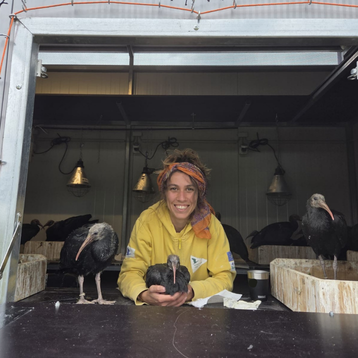
Fabienne Tilg
Foster Parent
Fabienne completed her Bachelor’s degree in Biology at the University of Innsbruck and is currently pursuing a Master’s degree with a focus on Ecology and Biodiversity. From an early age, she developed a great passion for animals and working with them. She has gained experience at several wildlife rescue and rehabilitation centers and, among other things, dedicated a year after graduation to the welfare and release of native wild animals in Portugal through an Erasmus+ volunteer program. Already in 2017, she was part of the human-led migration project to Italy. In 2023 and 2024, she also supported the ground team during the first and second migrations to Andalusia, Spain. Now, in 2026, she is taking part in the project for the first time as a foster mother, accompanying the young birds on their journey to Spain.
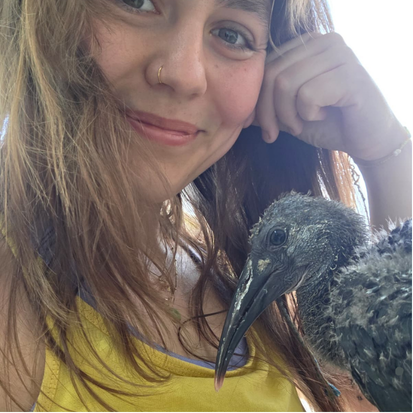
Eszter Bajka
Foster Parent
Eszter Bajka completed her Bachelor’s degree in Biology with a specialization in Zoology and is currently pursuing a Master’s degree in Conservation and Biodiversity Management at the University of Vienna. From an early age, she developed a great passion for birds and gained practical experience at various bird ringing stations, in animal care at Schönbrunn Zoo, and with Wildlife Rescue Vienna, where she was involved in raising young birds, among other tasks.In spring 2025, Eszter worked with the Northern Bald Ibis team in Schönbrunn preparing food for the birds, and during the summer she joined the ground team accompanying the human-led migration to Catalonia. This year, she is part of the Northern Bald Ibis team as a foster mother, helping the young birds find their way to Andalusia.
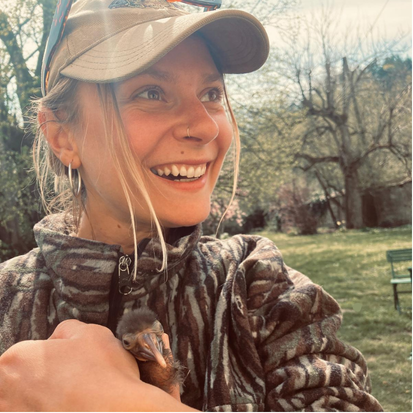
Amelie Muntschick
Camp coordinator
Amelie is a trained environmental scientist who feels most at home outdoors — with the sun on her face and mud on her boots rather than behind a laptop or in a laboratory. As a nature-loving nomad, the role of camp coordinator suits her perfectly.
Through her experience working in intercultural teams, environmental education, and the management of international conservation projects, she brings strong organizational skills, team spirit, and great enthusiasm for species conservation. She is very excited to accompany this year’s migration and to be part of this unique project.

Markus Unsöld
RESEARCH COOPERATION
During his biology studies at the LMU Munich, Markus was already involved with the Northern Bald Ibis and investigated the sun-bathing behaviour of these birds for his diploma thesis. He has been a member of the Waldrappteam since 2003 and participated in all human-led migrations from 2003 – 2014. He also took on the role of foster parent in 2008 and 2009. He is particularly interested in historical research on the Northern Bald Ibis and the mechanisms of emergence and passing on of migration traditions. Markus works full-time as curator of the ornithology section at the Munich State Zoological Collection.

Helena Wehner
RESEARCH COOPERATION
Helena Wehner has been part of the project since 2019 when she started working as foster mom for raising and training young Northern Bald Ibises to guide them to the wintering sites in Italy and Spain. She finished her Master of Science in Geography/Earth Observation at the University of Wuerzburg. In 2025 she started her PhD studies about multi-sensor, multi-parameter and large-scale analysis of animal migration pathways under a changing climate at the university of Wuerzburg and the German Aerospace Center. Beside supporting the hand-raising she assists in GPS-tracking and earth observation analysis.

Bernhard Völkl
RESEARCH COOPERATION

Walter Holzmüller
Walter Holzmüller is a professional pilot, flight instructor, and technician for ultralight aircraft and paragliders. Throughout his career, he has successfully participated in numerous competitions; in 2009, he became World Champion, and in 2012, Vice World Champion in the dual-seat powered paraglider trike category.Since 2007, he has been working for the company as a technician and, between 2007 and 2023, additionally served as a pilot. The two aircraft he uses have been specifically adapted by him to meet particular requirements and have been continuously further developed.Thanks to his extensive professional experience, he makes a significant contribution to the optimization of human-led migration and, consequently, to the success of the reintroduction project.